
Today, public access defibrillator (PAD) cabinets are a familiar sight across the UK. You’ll find them mounted on the walls of village halls, pubs, schools, sports clubs and supermarkets, as well as in phones boxes and even on remote walking routes. For many communities, the bright cabinet has become as recognisable as a post box. However, these cabinets are actually a relatively recent development, and their journey from specialist medical equipment to a community lifesaving asset is an interesting one. Here we track their development over the years, and look at the possibilities they hold for the future.

Background
The story really begins long before the cabinet itself. Defibrillators were originally large, expensive machines found only in hospitals. During the 1960s and 1970s, advances in technology led to the development of portable defibrillators, largely driven by pioneering work from Belfast cardiologist Frank Pantridge. His work helped prove that rapid defibrillation outside of hospital could dramatically improve survival rates from cardiac arrest. Over the following decades, defibrillators became smaller, lighter and more reliable, eventually leading to the development of automated external defibrillators (AEDs) that could be safely used by members of the public.
The start of public defibs
The UK’s first large-scale public access defibrillation programmes began to emerge during the late 1980s and 1990s. Early schemes were often located in transport hubs, airports and large public venues where there was a high footfall and a greater chance of witnessing a cardiac arrest.
While it is difficult to identify who manufactured the first public access defibrillator cabinet in the UK, dedicated outdoor cabinets began appearing as public access defibrillation schemes expanded across airports, railway stations and community locations. These early cabinets evolved from simple weatherproof enclosures into the heated, illuminated and remotely monitored cabinets commonly seen today.
One of the pioneers of public access defibrillation in the UK was cardiologist Douglas Chamberlain, who championed the placement of defibrillators in locations such as railway stations and airports long before they became commonplace.
National Defibrillator Programme
A significant milestone came in the early 2000s when the UK Government launched the National Defibrillator Programme. This initiative saw hundreds of AEDs installed in public places such as railway stations, airports, shopping centres and leisure facilities. For the first time, defibrillators were being placed specifically for use by the public rather than healthcare professionals. The programme helped demonstrate that ordinary people could successfully use AEDs and that early defibrillation could save lives.
A defib in a cabinet is worth two locked up….
As the number of publicly available defibrillators grew, a practical challenge emerged: where should they be stored? Initially, many AEDs were kept inside buildings, often behind reception desks or locked in offices. While this protected the equipment, it also meant access was limited to opening hours. Communities quickly realised that a defibrillator locked inside a building at night was of little use during an emergency outside those hours. This need for 24/7 accessibility drove the development of the modern public access defibrillator cabinet.
Humble beginnings- the early days of defib cabinets
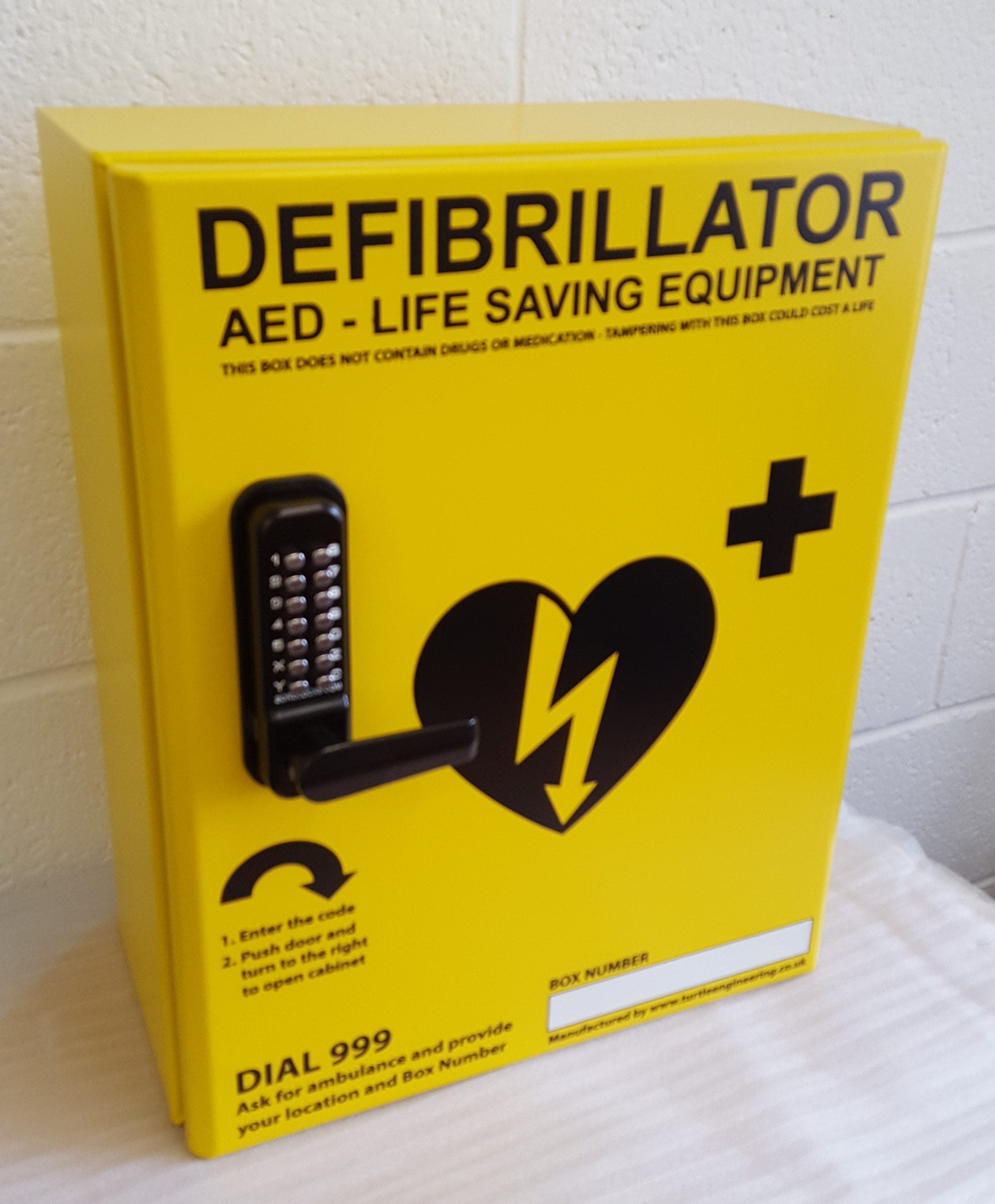
The first cabinets were relatively simple affairs. Typically made from metal or plastic, they provided basic weather protection and security. Many incorporated keypad locks, with the access code supplied by the ambulance service during a 999 call. This approach struck a balance between accessibility and protecting expensive equipment from theft or vandalism. Over time, heated cabinets became common, ensuring defibrillators could be stored safely outdoors throughout the British winter.
Enter Turtle
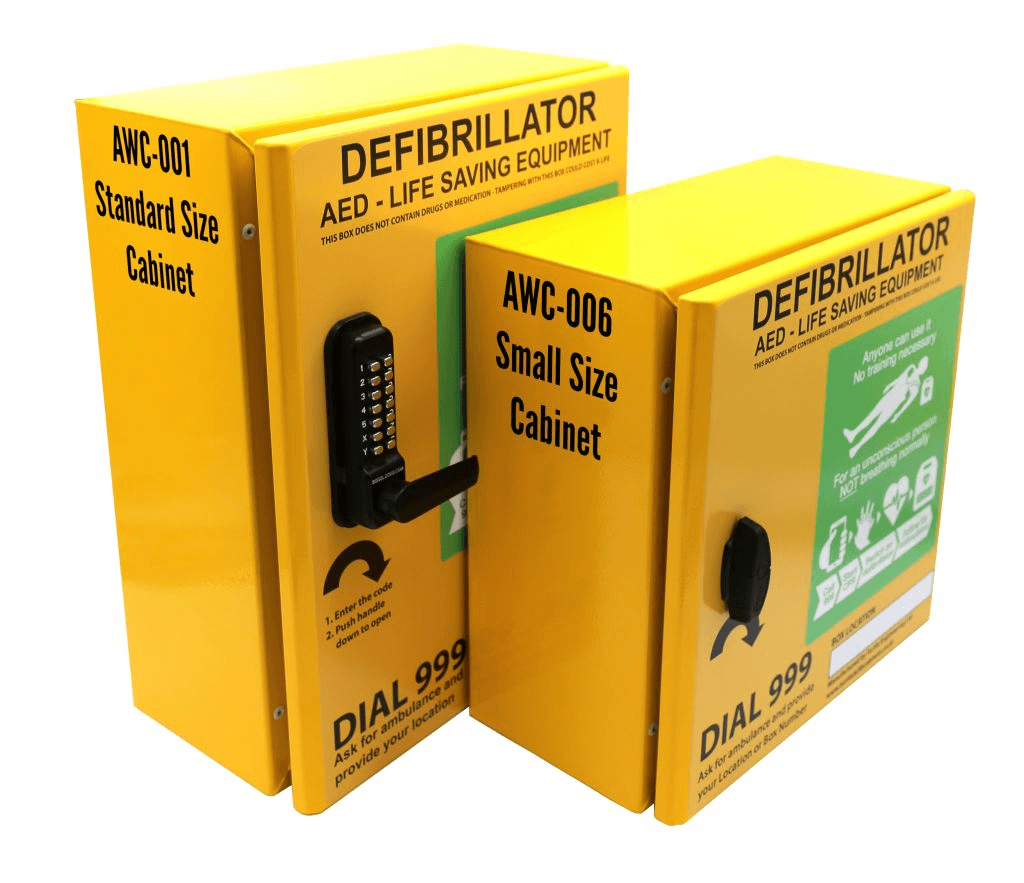
With a family history of dedicated CFR, combined with a degree in engineering, founder of the company Mike quickly spotted a gap- the rise in demand for public defib cabinets with no single manufacturer. The first cabinet Turtle Medical (then known as Turtle Engineering) produced was the AWC001, a medium sized cabinet designed to comfortably hold any public defib. Heated as standard, but with options of unheated/insulated for customers who were either without power or locating the cabinet indoors or in a particularly sheltered/warm setting. Traditionally yellow but with options for alternative colours, always metal with an IP66 rating and ten year warranty, available in locked or unlocked versions.
As modern public defibs got smaller, Turtle extended their range to include a set of smaller cabinets, measuring in at a compact 400x400mm.
Today Turtle Medical offer a vast range of cabinets, including our combined cabinets for a defib and bleed kit (more on these later) and our unique solar and wind powered cabinet, designed for locations with no access to mains power.

Did you know we also manufacture a large metal cabinet, measuring 500 x 500mm, that can fit a defib and one of our Enhanced PAcT kits?
Whilst we now also stock a comprehensive range of plastic cabinets for trauma kits, the cabinets we manufacture ourselves for external public defibrillators have always been metal. This reflects our commitment to quality, longevity and the environment (all our metal cabinets are recyclable).
Development of Defib Cabinets
Throughout the 2010s, public awareness of cardiac arrest and defibrillator availability grew significantly. Charities, community groups, sports clubs and local businesses began fundraising to install their own AEDs. Organisations such as the British Heart Foundation played a major role in increasing public access, helping fund thousands of devices across the country. As demand increased, manufacturers developed increasingly sophisticated cabinets featuring thermostatic heating, lighting, alarms and remote monitoring systems.
The iconic yellow cabinet became particularly common during this period. Highly visible and instantly recognisable, these cabinets helped make defibrillators easier to locate in an emergency. At the same time, ambulance services began maintaining increasingly comprehensive databases of AED locations, allowing 999 call handlers to direct members of the public to the nearest device.
In recent years, the focus has shifted from simply installing cabinets to ensuring they remain rescue ready. Modern public access cabinets can now incorporate heating, ventilation, door-open alarms, remote monitoring, GPS tracking and automatic fault reporting. These technologies help custodians ensure that the defibrillator remains available when needed, rather than discovering a problem during an emergency. Many communities now view ongoing management and monitoring as being just as important as the initial installation.
Talk to Turtle Medical for more information on the following ways you can make your defib cabinet work harder for you:
- Add light/alarm/rain canopy for increased visibility/security/weather protection
- Add remote monitoring (ideal for those who have multiple cabinets to look after)
- Add customisation- sponsors/councils/family of lost loved one can add their logo/text/message to the front cabinet design
- Register your cabinet- so your local ambulance service knows its there and rescue ready
Not just for defibs…..
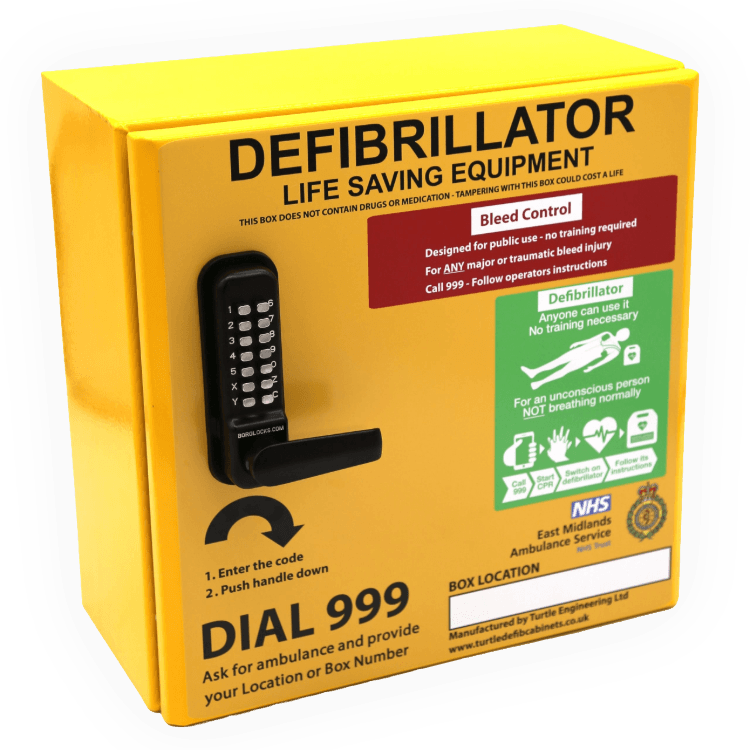
Daniel Baird’s death in 2017, whilst not due to a cardiac arrest, has certainly influenced the evolution of public defib/medical cabinets. Just like defibs in the past, Daniel’s mother discovered early on that the bleed kits she designed with West Midlands Ambulance following the loss of her son to knife crime were of limited value when stored inside buildings that were locked overnight. With quick access key, the kits needed to be located in public access cabinets, in the same way as public defibs.
Turtle Medical is proud to have been partnered with The Daniel Baird Foundation since 2021, and still donate to the charity with every kit we sell. More and more customers are requesting one of our combination cabinets, with a custom print that reflects the dual contents of public defib and bleed kit.
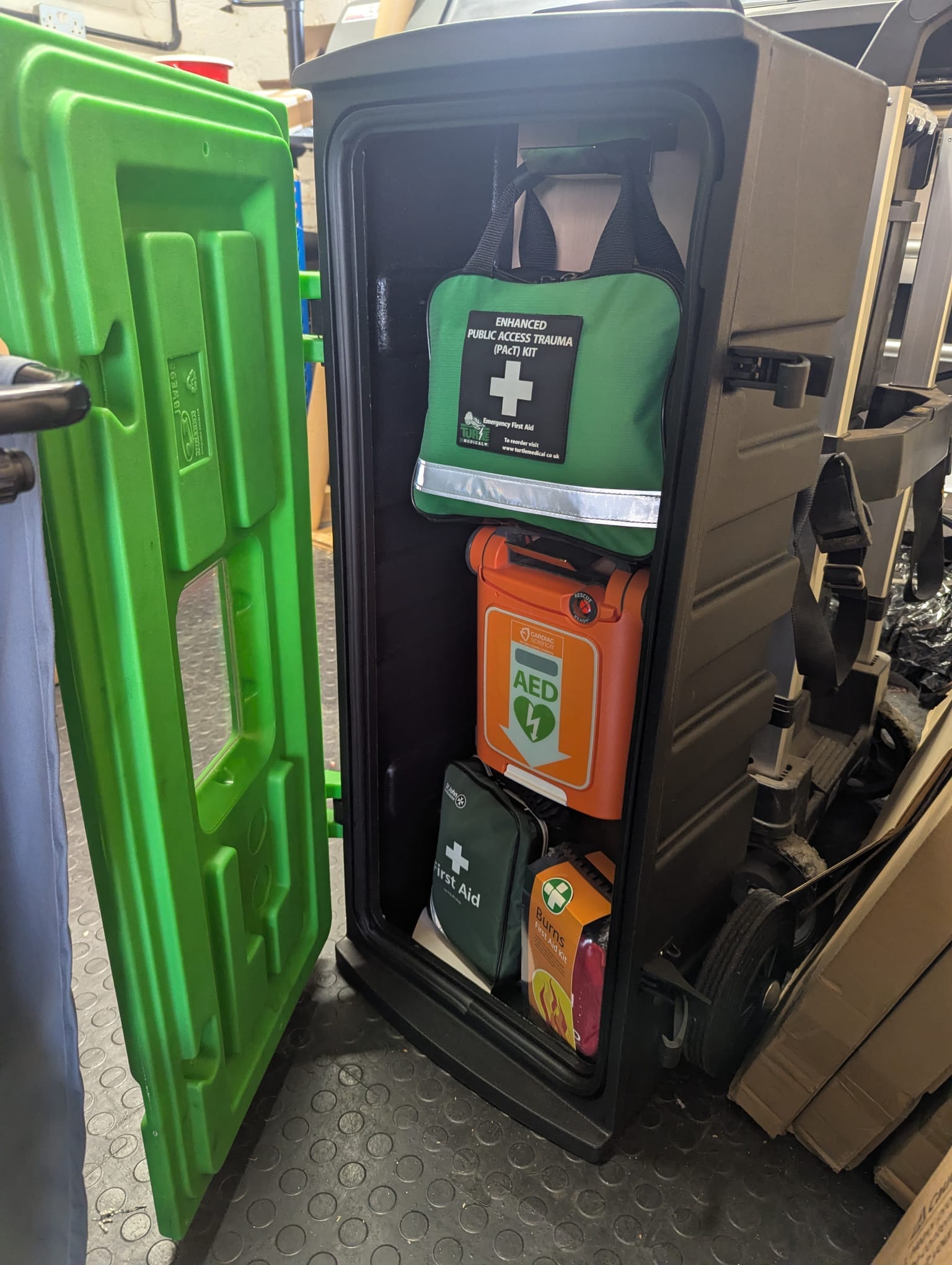
And with Martyn’s Law compliance required by all large organisations by 2027, more customers are now looking for a cabinet that is big enough to hold not only a defib and a bleed kit, but a defib plus a PAcT kit. There has been a subtle shift from seeking the smallest most compact cabinet to looking for a cabinet that can be an emergency ‘hub’, containing a range of emergency medical items such as:
- defibrillator
- bleed kit or PAcT kit (find out the difference in our other blog: Which Bleed Kit? )
- Diabetes Kit
- Life Vac anti-choking rescue device
Today’s Defib Cabinets
Today, the UK has tens of thousands of public access defibrillators, and the cabinet has become an essential part of the country’s emergency response infrastructure. What started as specialist hospital equipment has evolved into a community asset that can be accessed by anyone, at any time, often within minutes of a cardiac arrest. The humble cabinet mounted on a wall represents decades of technological development, medical research and community engagement, all working towards one goal: giving more people the chance to survive a sudden cardiac arrest.
The great thing about public access defibrillator cabinets is that their story is still being written. As technology continues to advance, we are seeing the emergence of smarter cabinets, remote monitoring platforms, solar-powered installations and integration with emergency service databases. They are also becoming emergency ‘hubs’ containing other emergency medical items designed to save lives at risk from not only cardiac arrest but also: catastrophic bleeds, diabetic lows and choking.
The future may bring even greater accessibility and reliability, but the principle remains unchanged from those early schemes: getting lifesaving equipment into the hands of a bystander as quickly as possible, which really can mean the difference between life and death.
See below for our handy guide to Turtle Medical’s range of defib cabinets, which are now often customised as combined cabinets for our customers who wish to include a bleed/trauma/PAcT kit in their emergency medical cabinet. See our page on bleed control kits for details of the Diabetes kit and Life Vac as well as our range of trauma kits.
| Model | Price (£) | Size (mm) | Heated | Locked | Combined (Defib & Bleed) | IP66 rated | 10 year warranty | Description |
|---|---|---|---|---|---|---|---|---|
| AWC001 | 525 | 500 x 400 | Yes | Yes | No | Yes | Yes | Medium size- defib only (all brands fit) |
| AWC001C | 525 | 500 x 400 | Yes | Yes | Yes | Yes | Yes | Medium size- defib & bleed kit on hooks |
| AWC002 | 450 | 400 x 400 | Yes | Yes | No | Yes | Yes | Small size- defib only (all brands fit) |
| AWC002C | 450 | 400 x 400 | Yes | Yes | Yes | Yes | Yes | Small size- defib on hook, bleed kit tucks in |
| AWC003 | 475 | 500 x 400 | Yes | No | No | Yes | Yes | UNLOCKED version of 01- medium size |
| AW004 | 375 | 400 x 400 | No | Yes | No | Yes | Yes | Small size- defib only- UNHEATED |
| AWC004-ins | 410 | 400 x 400 | No | Yes | No | Yes | Yes | Small size- defib only- INSULATED |
| AWC004C-ins | 410 | 400 x 400 | No | Yes | Yes | Yes | Yes | Small size- defib & bleed- INSULATED |
| AWC005 | 325 | 400 x 400 | No | No | No | Yes | Yes | Small size- UNHEATED UNLOCKED |
| AWC006 | 410 | 400 x 400 | Yes | No | No | Yes | Yes | UNLOCKED version of 02- small size |
| AWC007 | 600 | 500 x 500 | Yes | Yes | No | Yes | Yes | Large size- can fit defib & PAcT kit |
Still unsure? Call 01327 220722 to speak to us- Amy, Mike and Lucy can help you choose the right cabinet for your location.
