
As we mark the 9th anniversary of Daniel Baird’s tragic death this month, it seems fitting to take a moment to reflect on the incredible journey that bleed kits have been on, from their conception to today, when there are now more than 35,000 The Daniel Baird Foundation bleed kits deployed across the UK, being used on average 4-5 times a week. Credit must go to Lynne, Daniel’s mum, and the rest of the family, who still work tirelessly to tell Daniel’s story, get kits into communities and, ultimately, save lives.
Turtle Medical is proud to call The Daniel Baird Foundation their Charity Partner, and since 2021 have been supporting the Foundation with the manufacture of both the bleed kits themselves as well as the signature red metal bleed control cabinets, seen now not only on the streets of Birmingham (where Daniel lost his life) but all over the country.
Today communities are far more aware of the dangers of catastrophic bleeds, have a choice of how and where to locate bleed kits, and are able to register them with the ambulance service so they can be accessed quickly in the event of a bleed. With Martyn’s Law firmly on the horizon, bleed kits are not only here to stay, but set to see even bigger growth in their deployment, becoming widely available in all popular public spaces, from transport to sports and leisure, places of worship and education, and of course community centres and events.
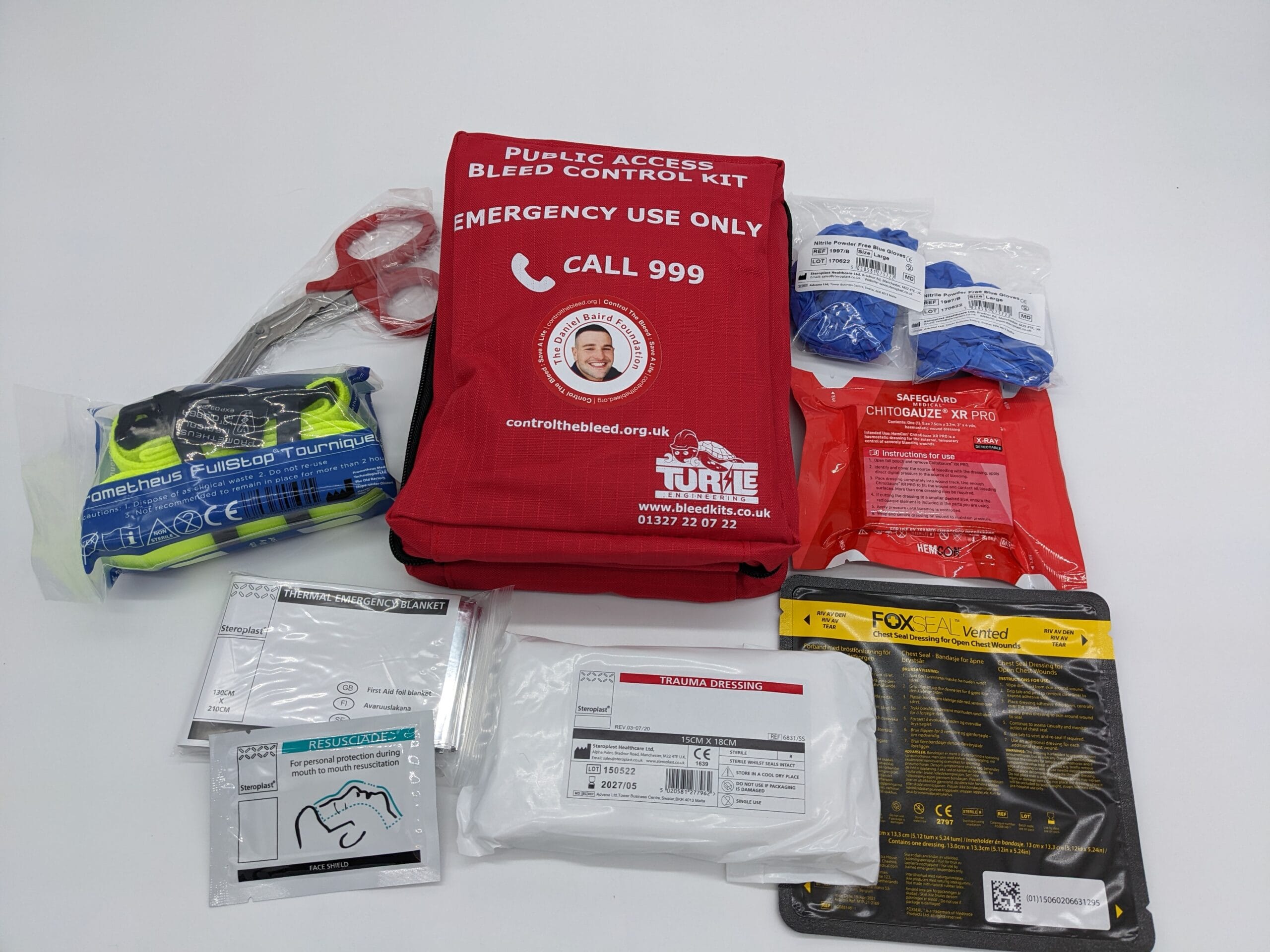
It feels hard to believe that before 2017 there were simply no public bleed kits. Not one. And yet we know there were plenty of bleeds. Here at Turtle Medical we hear so many examples of bleeds on a weekly basis, and only a small number of them ever reach the local, let alone national news. Here are some exmaples of real-life accidents that we have been told about where a bleed kit has been used.
- Road traffic incidents: bleeding injuries have ranged from seat belt lacerations to tree branches and other objects piercing windscreens, motorbike riders have suffered horrendous limb and torso wounds, whilst pedestrians are often the most vulnerable when they come into contact with a road vehicle. One lady was treated after a road traffic accident outside a school – luckily the school had a bleed control kit outside in a public cabinet.
- Workplace injuries: workers operate cutting equipment and machinery, a local butcher and a large manufacturing factory have used bleed kits.
- Bleeds at home: gardening, cooking, even slipping on uneven or icy ground have all caused bleeding injuries in and around people’s homes.
- Self-harm: with mental health issues arguably at an all time high, sadly there are many incidents of bleeding injuries caused by self-harm.
- Recreation and sport: there was the 10 year old boy who tripped over a kerb playing football and the dad who tripped over his own flip flop whilst throwing/catching a rugby ball with his son (yes really). An elderly lady fell at her local social club (we like to think she was having a good time dancing to an Elvis impersonator at the time but this has not been confirmed) and a man who cut into his own leg by mistake during a tyre change (new punctured wheel proved tricky as cover secured by cable tie). These bleeds are the most unexpected, the most unpredictable and therefore often the hardest to treat. With only 3-5 minutes to control a critical bleed, kits must be readily available, quick to access, and easy to use.
Incidents like this happen every day and then there’s the additional pressure on our emergency services managing knife crime and violent attacks.
Most of you know the story of how public bleed kits came about; Daniel’s mum refused to accept that his death was unavoidable, and with the help of the ambulance service designed a kit that could be put into public spaces for future incidents. Lynne didn’t realise the impact of these kits at the time, and how they would come to be a common medical emergency item in public spaces like defibrillators.
In the old days of course (2018-2021) the kits were donated to schools, pubs, nightclubs, locations that were considered high risk or with high footfall/vulnerable community members such as children/teenagers. 2021 was a hugely significant year, with the first bleed control cabinets – created by us here at Turtle – appearing. Now the bleed kits could be made available 24 hours a day, 7 days a week, 365 days a year. Whether your bleed cabinet is locked or unlocked, attached to a wall, fence or railings, or customised, it allows the public to access a kit at any time.
Turtle has always encouraged customers to register their bleed kits/cabinets with the ambulance service, like public defibs are registered on The Circuit. Excitingly, in January 2026 Bleed Map was launched, a charity database enabling all bleed kit owners across the UK to register their kits (as long as the kits are located in a fixed location). Over 5,000 kits have already been registered in the last 6 months, which is evidence of its popularity as a tool. Turtle customers have been asking for such a tool for a long time. A national database is so important as it allows ambulance services to deploy equipment not only locally, but across borders and neighbouring services.
So when you buy a bleed kit today, you are investing in a national infrastructure of emergency medical equipment. Not bad for £85.
Where do bleed kits go from here?
It is a bizarre coincidence that Daniel Baird and Martyn Hett both died in 2017. Starkly different circumstances, but both have left their legacy. Thanks to another devoted and hard-working mum, Figen Murray, Martyn’s Law is set to transform how venues prepare for the unexpected, including catastrophic bleeds.
Whether the injury is caused by a terrorist attack, a gunman or attacker wielding a knife, or indeed due to an explosion, collapsed building, or other large scale incident, bleeds can and do occur unexpectedly, and venues will now be expected to be ready.
Turtle Medical, through its work with the Daniel Baird Foundation, as well as collaborations with the police, ambulance and fire services, transport companies, construction industry and community projects, know all about critical bleeds. The Turtle Enhanced PAcT kit is an expanded version of a Daniel Baird bleed kit (with a few additions) and not only complies with Martyn’s Law, but exceeds it.
Venues coming to us for Martyn’s Law provision can feel confident that we can advise on best practice, whether they are a university, football stadium or council planning a Christmas market.
From the original Daniel Baird kit, to the Enhanced PAcT, to larger/bespoke trauma options, we have a trauma kit, matching cabinet, and even training for you.
The future of bleed kits looks bright.
